Traffic light method
Added Value
- Encourage participation from all participants
- Draw attention to the teaching content
- Ask for opinions or knowledge of the participants to get an overview or to get hints for further action
At a Glance
Procedure
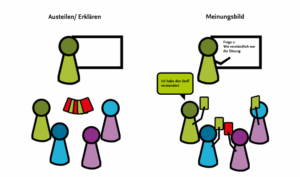
All participants receive cards in the colours red, yellow and green. The teacher formulates questions or statements about comprehension or current events to get an opinion. After each statement, the participants have to decide whether they agree (green card), disagree (red card) or are still undecided (yellow card). For yes/no questions, the green card stands for ‘yes’, the red for ‘no’ and the yellow for ‘I don’t know’. The voting results can be recorded, but should not be commented on or evaluated at first. The traffic light method can also be implemented in classroom teaching with digital tools. Audience response systems are suitable for this.
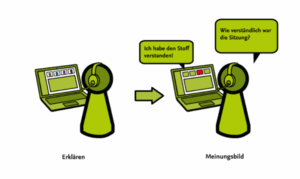
The method can also be implemented in digital teaching via a video conferencing system. All participants are asked to have the first red, yellow and green object they find at hand and turn on their cameras. The trainer formulates questions or statements about comprehension or current events to get an opinion. After each statement, the participants have to decide whether they agree (green card), disagree (red card) or are still undecided (yellow card). For yes/no questions, the green card stands for ‘yes’, the red for ‘no’ and the yellow for ‘I don’t know’. The voting results can be recorded, but should not be initially commented on or assessed. The traffic light method can also be implemented with little effort using audience response systems.
Tips for Implementation
Organisation:
· The traffic light method can be used at different points: Classically, it can be used at the end of class for evaluation. However, it can also be used after a work process or during a lecture to check the participants’ level of knowledge or whether information can still be absorbed. It can also be used as an introduction to a topic to find out what prior knowledge or interests the participants have.
· With open, non-anonymous polls, there is a risk that students will adapt their answers to the presumed expectations of the teachers. For this reason, it is recommended to make the meaning and consequences of the poll transparent in advance, e.g. repetition of the material or adaptation of the teaching.
Digital Organisation:
· If the traffic light method is done regularly, instead of an object of their choice, it can be useful to ask the participants to have coloured papers ready which can be hold in the camera lens. In this way it is possible to capture a colour scale easily at a glance.
· For participants who do not turn on their camera, there is the possibility to vote through digital reactions such as ‘thumbs up’, ‘thumbs down’ and ‘clapping’.
Variants:
· The traffic light method can be used at the beginning and at the end of a series of topics on the same questions or statements in order to make the change in attitude or the increase in knowledge on a topic visible.
· The traffic light method can also be implemented in classroom teaching with digital tools. Audience response systems can be used for this purpose.
Application Scenarios
- Capture the spectrum of opinions
- Determining prior knowledge and learning success
- Inquiring interests
- Further develop teaching on the basis of student feedback
Material & Digital Tools
- Red, yellow and green cards in DIN A6 for all participants
- Digital survey tools such as eduVOTE,Particify,Slido, Vevox, Wooclap
- Video conferencing systems such as BigBlueButton,Webex
Further Literature

